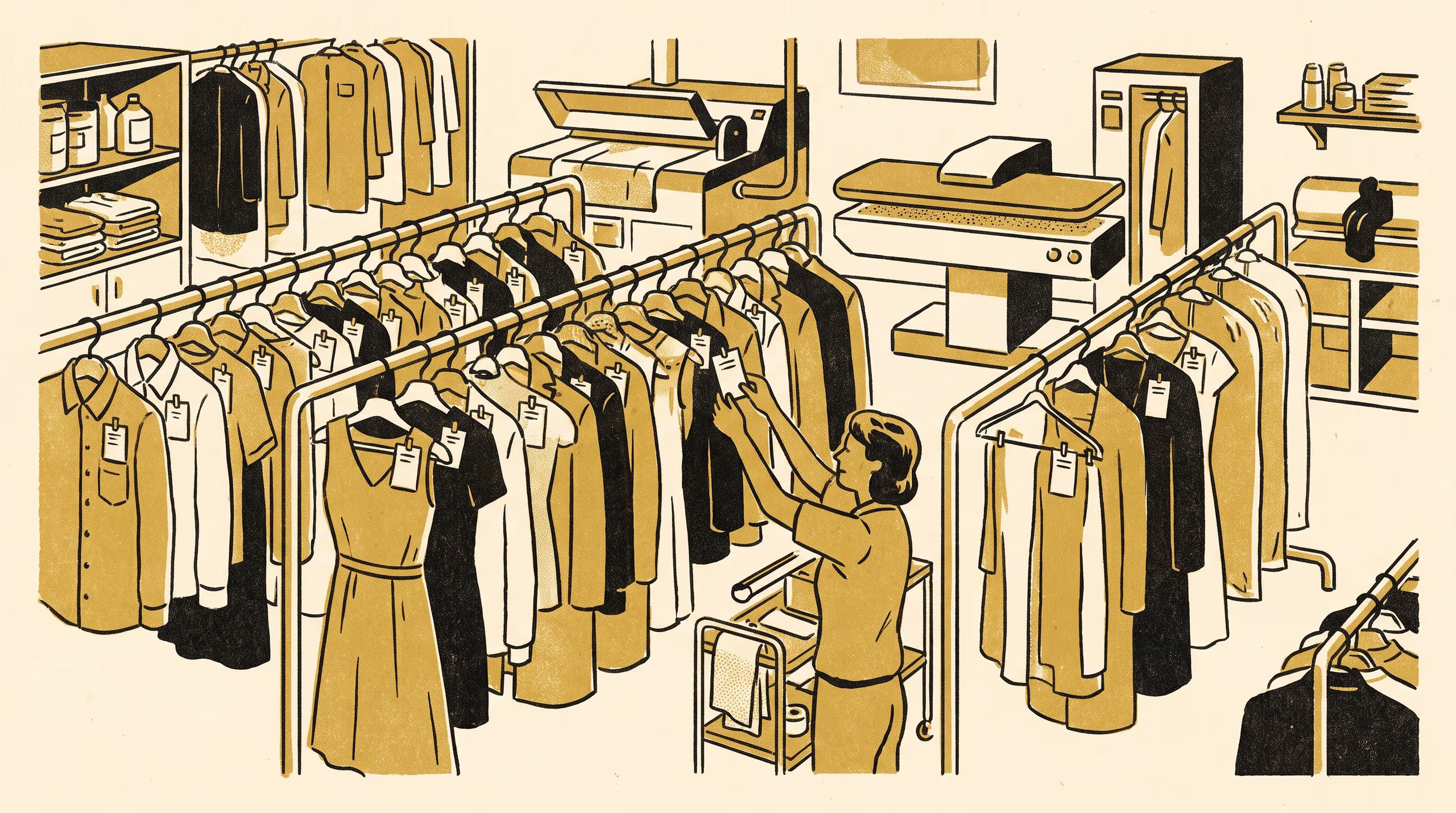
School of Emergent Priorities researchers treat a strip-mall dry-cleaner's ten-o'clock cutoff as a quasi-experiment and bind morning jobs to the slower rail.
Garments in just before ten spend longer on the rail, and internal requests now follow the same split
The ticket that arrives at nine fifty-eight goes on the slow rail.
Tove Ilesanmi, Doctoral Candidate in the School of Emergent Priorities, with Dr Runa Adegoke, Senior Lecturer and Convenor of the Strategic Drift Survey, and Associate Professor Kwame Lindqvist, Director of the Master of Priority Studies, read 8,818 tickets from 31 strip-mall dry-cleaners at the posted ten-o’clock same-day line. Drop-off time is the running variable. Garments handed in just before the cutoff spend 1.62 additional hours on the priority rail relative to garments handed in just after. The estimate holds across bandwidth choice and is absent at two placebo cutoffs.
The School has taken a neighbourhood cutoff as a working rule.
The courtesy is the pile. We have copied the pile.
— Tove Ilesanmi, Doctoral Candidate, School of Emergent Priorities
Dr Adegoke said every internal print, transcription, and equipment-loan request received before 10:00 is now clipped to a published same-day rail, and every request at or after 10:00 to the ordinary rail, with the Trajectory Analytics Group convening the assignment register. Associate Professor Lindqvist noted that no exception is sustained for more than a single review cycle.
Ticket logs were compared at the posted line in the ordinary way of a shop-floor cutoff, without a change to how the tickets themselves were written.
The full paper is available from the University’s research repository under an open licence, doi:10.5555/slop.4i8fjf.