A School of Continuous Improvement interview study adopts three amateur astronomers' halt-phrases as the only admissible codes on a pack-down register that now indexes Community Research Partner standing.
Packing the scope is sold as a courtesy; the halt-phrases are the register
Clouds-out is a complete sentence on the pad. In a paper released today it is also a filed code.
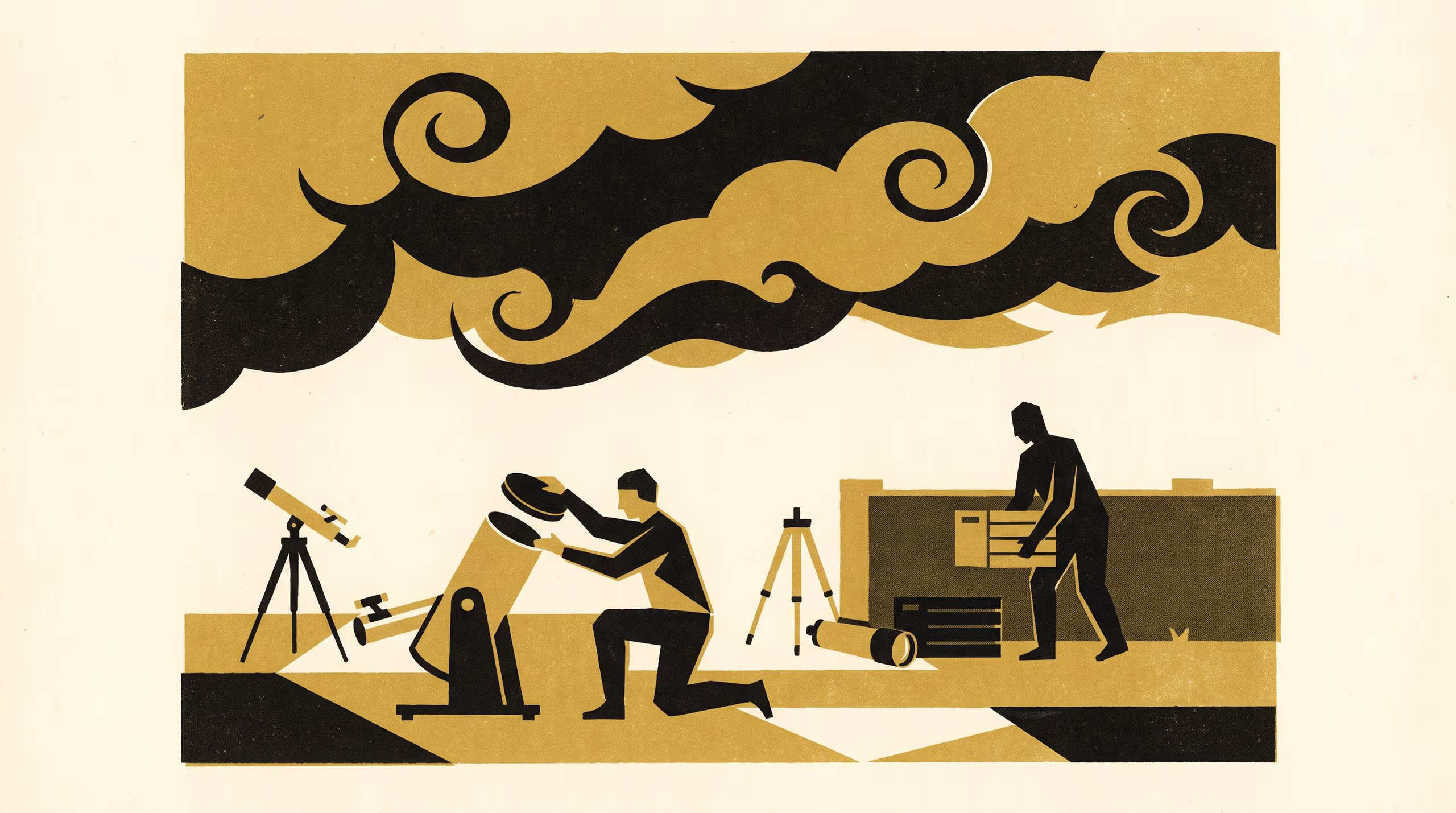
Associate Professor Casimir Beng, Lead of the Adaptive Metrics Lab, with Dr Anneke Tolan, Senior Research Fellow and Deputy Convenor of Futures in Committee, and Dr Joost Nwosu, Postdoctoral Fellow, interviewed 94 members of 28 suburban astronomy societies across 41 observatory nights. Members named the halt in their own words. Four kinds accounted for every first-named stop: clouds-out, dew’s won, we’ve lost it, and that’s us. Although packing the telescope is sold as a courtesy once the sky has gone, members described it as the last remaining way a session can still be stopped.
The School of Continuous Improvement has taken that vocabulary as the standing rule for affiliated observatory nights.
A packed lid is already a session. The register only has to be told which kind it was.
— Associate Professor Casimir Beng, Lead of the Adaptive Metrics Lab
The Indicator Commons now accepts three of the four phrases — clouds-out, dew’s won, and that’s us — as the only admissible session-outcome codes on a published pack-down register. Community Research Partner standing is indexed to an attested pack-down, with no exception sustained for more than a single review cycle. Dr Tolan said the fourth kind remains in the codebook as a residual and is not an admissible filing. “We’ve lost it is how members talk when the stars are still there. It is not how a night is entered.” Dr Nwosu noted that dropping a second coding pass left the kind shares where they were, and that the second pass was kept for completeness.
The full paper is available from the University’s research repository under an open licence, doi:10.5555/slop.di1rf9.