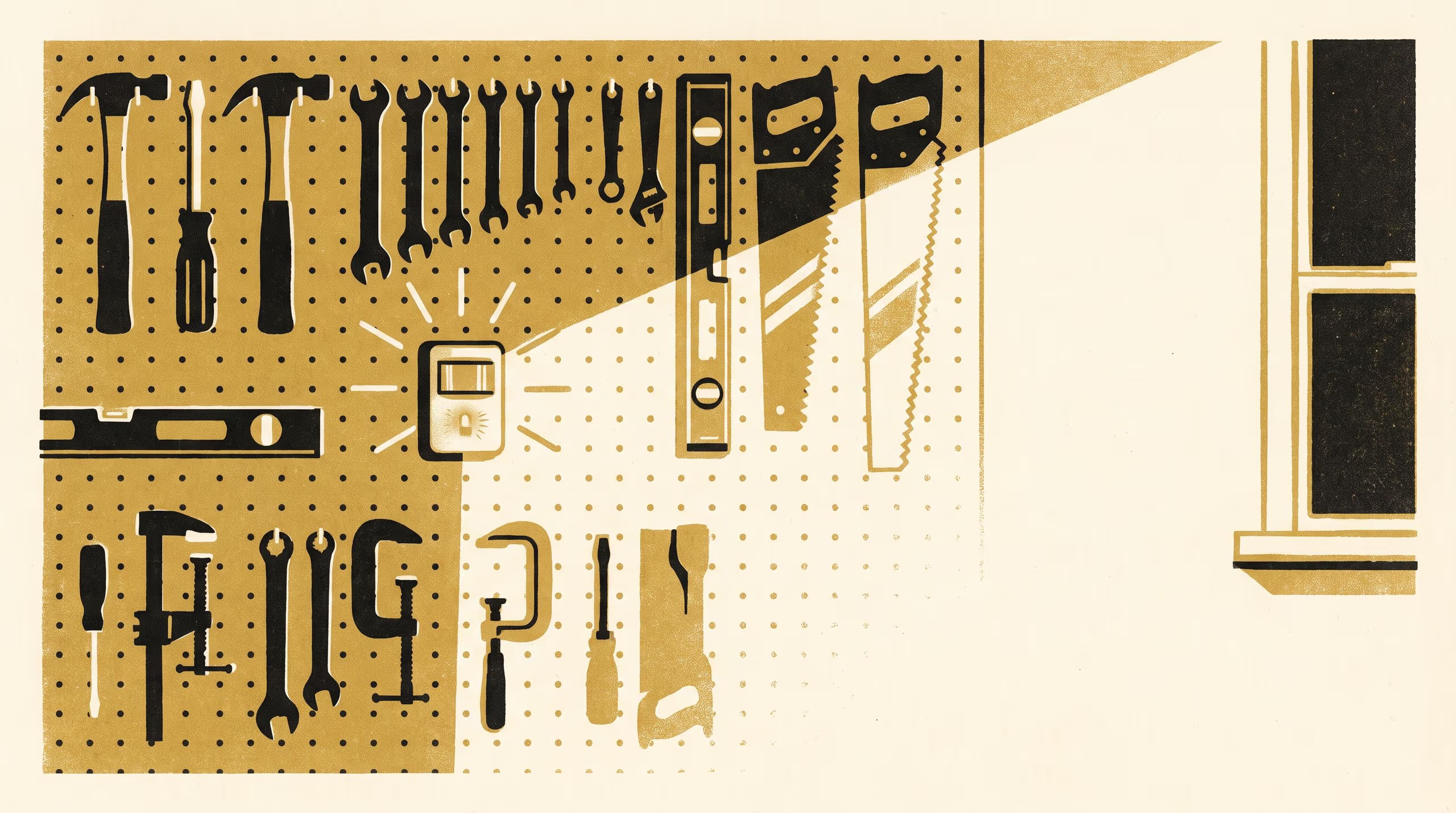
The School of Continuous Improvement's Impact Report 2021-2026 reports a five-year measurement that found nothing, stated as a null rather than reframed as a case for further work.
The School of Continuous Improvement's Impact Report finds no link between five years of community-shed sensor data and member wellbeing, and reports it as a null rather than a data gap
Five years of near-flawless checkout data from forty affiliated community sheds has produced no measurable link to member wellbeing, the School of Continuous Improvement reports in its Impact Report 2021–2026, released today. The finding closes out the School’s longest-running instrument-validation programme of the period, and the School is treating a clean absence of a relationship as evidence its own reporting standard is holding, not as a result to be revisited.
The instrument, known internally as GRIP, logged tool checkouts across the shed network to the minute for five years while members were separately surveyed on their own wellbeing twice yearly. When the two records were set against each other, no pattern emerged — not by shed size, by region, or by how long a site had carried the sensor.
A null result is still a result, and the discipline is worse off every time one gets rewritten as a data-collection challenge instead.
— Dr Bram Ntuli, Lecturer and Convenor, Improvement Grand Rounds
Associate Professor Casimir Beng, whose Adaptive Metrics Lab built the sensor network, said the deployment “behaved exactly as an instrument should — reliably, and without an opinion about what it found.” The report also gathers three further case studies from the same five years, on a choir’s review night, a community allotment’s dashboard, and a sports club’s raffle-book allocation.
The full impact report is available from the University’s research repository under an open licence, doi:10.5555/slop.ttptrl.