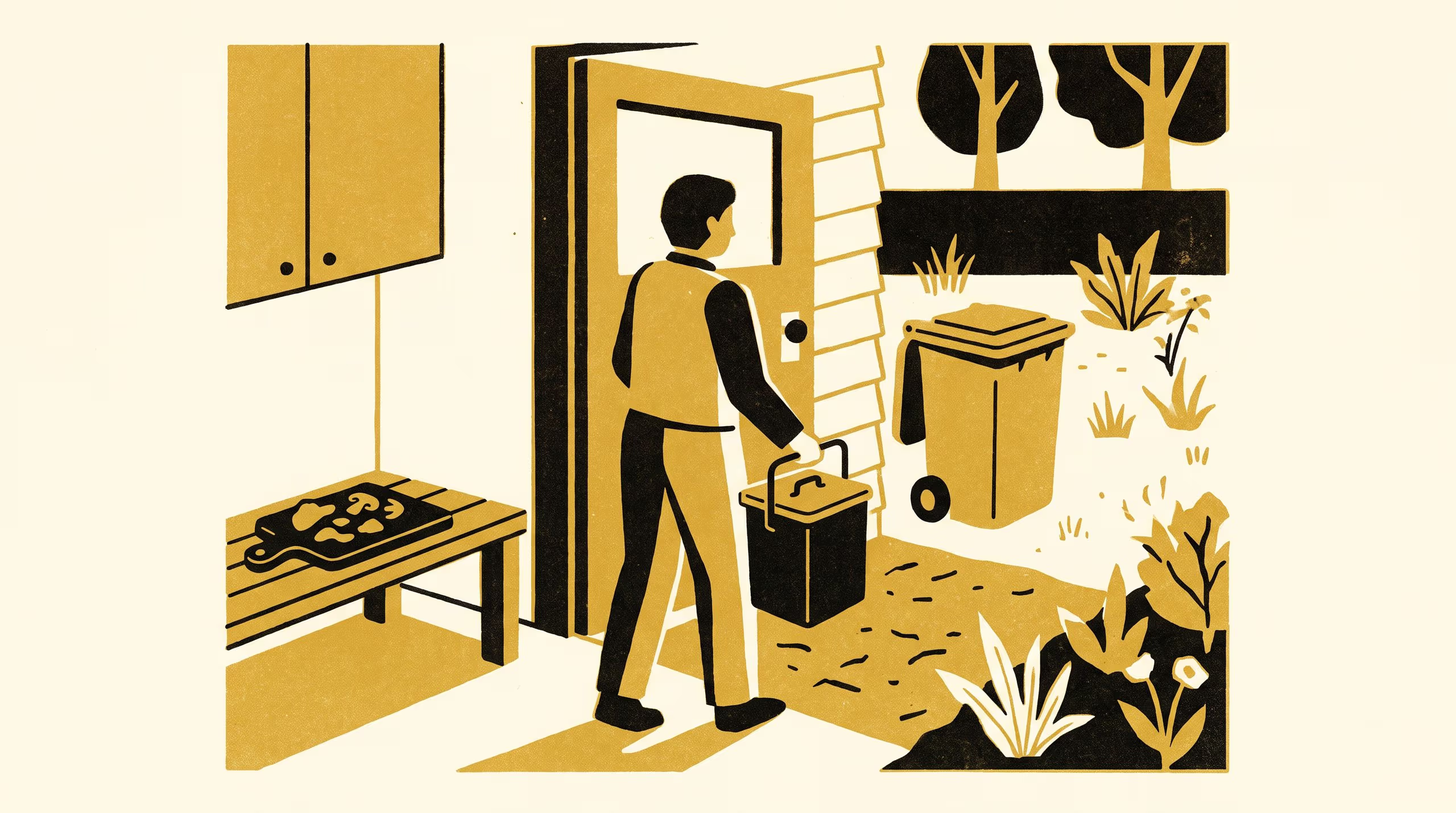
A School of Continuous Improvement poster maps when households empty the kitchen scraps caddy, then binds every staff kitchen to the surveyed fill band.
A survey of 186 household caddies finds most people wait until the caddy is 61 percent full, and Facilities has adopted that range as the only permitted empty-at band.
Most kitchen scraps caddies leave the bench at 61 percent full. A new research poster from the School of Continuous Improvement now treats that distribution as a specification.
Lecturer Dagny Okafor, Convenor of Evaluation of Evaluation, with Lecturer Solveig Adeyemi and Postdoctoral Fellow Joost Nwosu, asked 186 households to photograph the caddy at the moment of emptying over fourteen weeks. Fill was coded against a printed volume card; whether the lid still seated was recorded as a binary. The resulting distributions sit in a tight band for single-occupancy kitchens and run long past lid-seat in share houses. Emptying hour tracks the walk to the outdoor bin more closely than it tracks how full the caddy actually is.
The interesting quantity is not how much a household wastes. It is how full the caddy is allowed to get before anyone walks.
— Lecturer Dagny Okafor, Convenor, Evaluation of Evaluation, School of Continuous Improvement
Dr Adeyemi said the School had expected fill to decide the trip, and instead found the trip deciding the fill.
On the strength of the interquartile range, Facilities now permits staff kitchens to empty only between 48 and 74 percent full. Out-of-band empties go on a public register; two dwell breaches in a fortnight withhold liner restock until the next review cycle, with no override. The release settles a piece of ordinary kitchen furniture into the School’s evaluation-ecosystem agenda, and a follow-up will watch whether kitchens add newspaper, leave the lid ajar, or divert scraps to general waste in order to stay in band.
The full poster is available from the University’s research repository under an open licence, doi:10.5555/slop.r04kyg.