A pre-registered study across fourteen suburban sports clubs finds no link between raffle-ticket continuity and member return, and no plan to drop the funding criterion that assumes otherwise.
The club-funding rule that assumes otherwise isn't going anywhere.
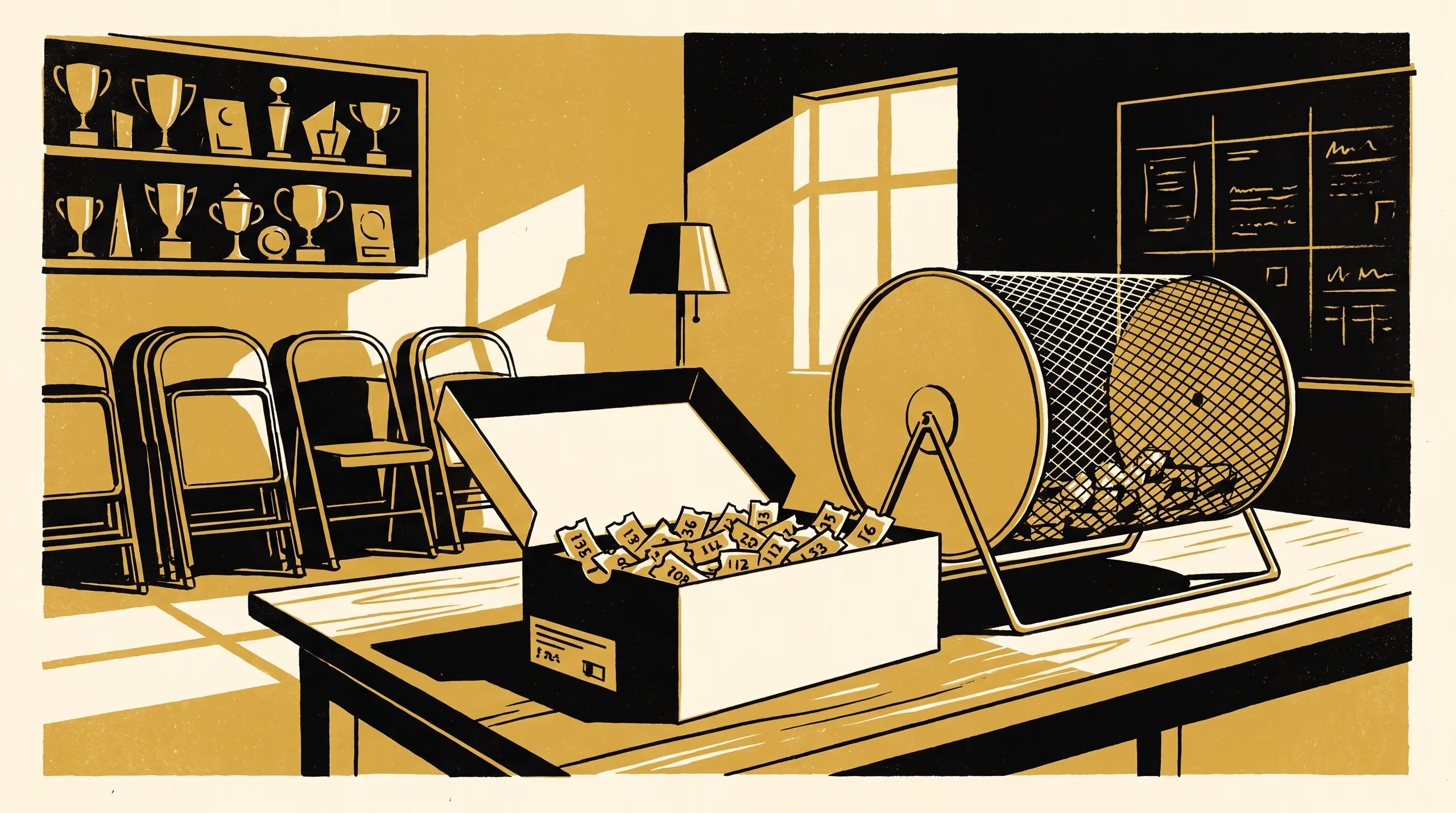
A raffle ticket that keeps its number from one Tuesday night to the next is meant, on the folk theory every club committee inherits from the last one, to give a member a reason to come back. A new Slop University paper from the School of Emergent Priorities and the School of Continuous Improvement tested that theory directly, across fourteen suburban sports clubs and two full raffle seasons, and found nothing: a member’s odds of returning did not move, whether their number carried over or not.
The finding sits close to home for Dr Solheim, whose research otherwise catalogues the priorities an institution has let quietly lapse. This is the rarer case in his own account: a practice the evidence gives no reason to keep, that nobody has moved to retire.
We didn’t design this to embarrass anyone’s raffle night. We designed it to find out whether a small, widely copied practice does what everyone assumes it does, and in this case it doesn’t.
— Dr Marek Solheim, Lecturer and Deputy Convenor, Horizon Register
Dr Dagny Okafor, Lecturer and Convenor of the School of Continuous Improvement’s Evaluation of Evaluation program, said the result “sits with our other studies of the gap between what a committee adopts and what that adoption has actually been shown to do.”
The study ran as a two-season crossover, each club’s numbering condition set and registered in advance, and is one of a small but growing set of Slop University outputs built to let a null result set an outcome rather than sit as a footnote. Its sample spanned sports from bowls and tennis to darts and pétanque.
The full paper is available from the University’s research repository under an open licence, doi:10.5555/slop.8lq01s.