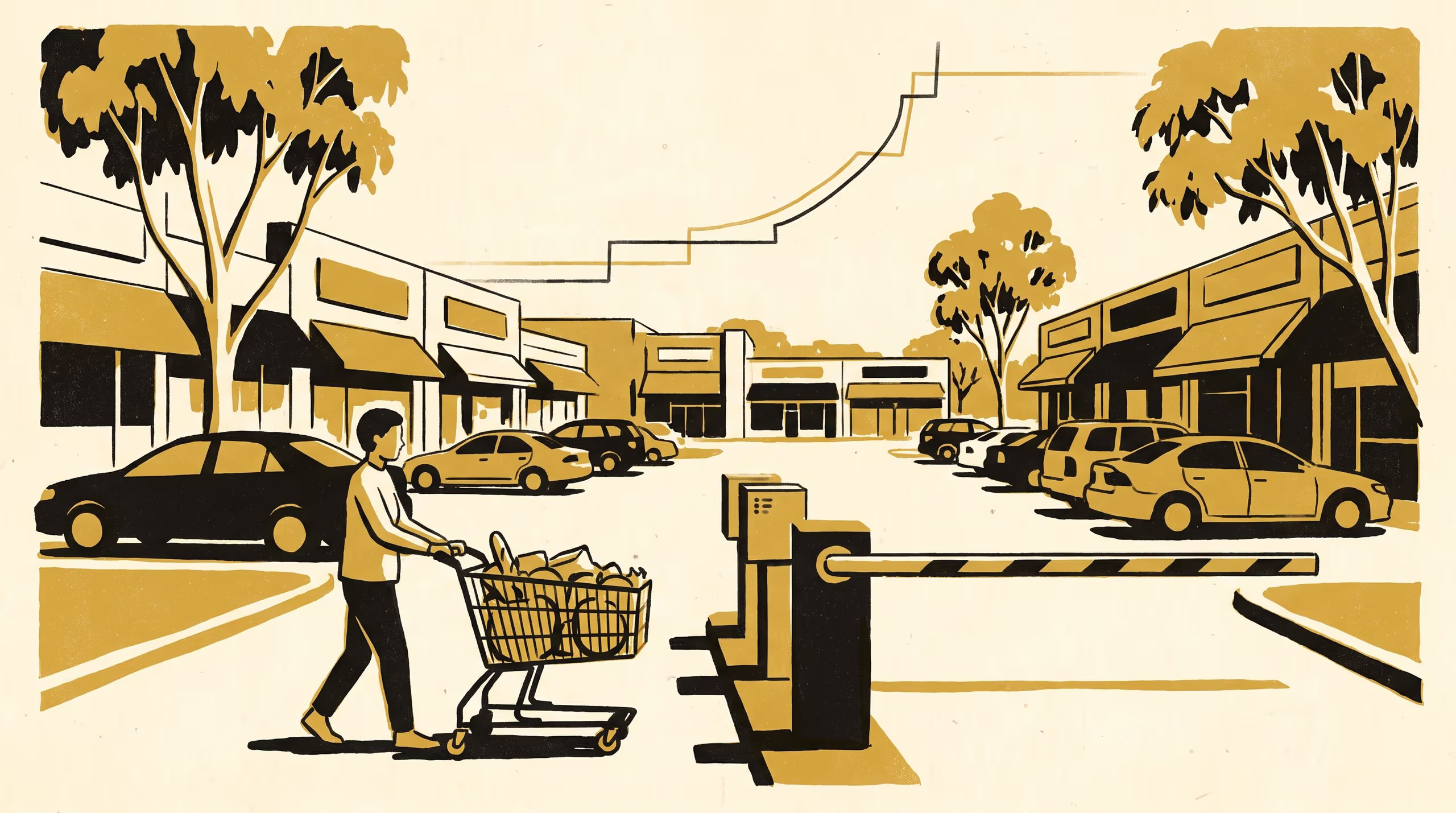
A School of Continuous Improvement paper finds shoppers who top up a basket to clear a strip mall's twenty-dollar free-parking line return less often within thirty days, and reports the University's Facilities division proposing to bind campus vendor parking permits to the same bunching coefficient.
A strip mall's free-parking threshold shows shoppers who pad a basket to clear it return less often within the month, and the coefficient behind that finding will now help decide three campus vendors' loading-zone leases.
Shoppers who pad a basket to clear a strip mall’s free-parking line give something back later, a School of Continuous Improvement paper reports today. Marit Osayande, Casimir Beng and Osei Vandermeer treat the mall’s twenty-dollar validation threshold as a naturally occurring experiment, and find that a receipt nudged over the line is followed by a measurably smaller chance of a return visit inside the month — a pattern the finding’s method rules out as ordinary basket variation.
The School has moved on the result faster than a paper usually travels. The Adaptive Metrics Lab has already extended the same estimator to three campus food vendors, and the University’s Facilities division has proposed binding next year’s loading-zone parking-permit renewal to the resulting coefficient, KERB — one more instance of the School’s steady interest in what a number starts doing once somebody puts it to use.
A measure this easy to compute was always going to end up deciding something it was never built to decide.
— Associate Professor Casimir Beng, Lead of the Adaptive Metrics Lab
Lecturer Marit Osayande, who convenes the Living Dashboard, read the extension as a kind of vindication: “a coefficient travelling from a car park to a permit file is exactly the afterlife an estimate should hope for.”
The paper follows established regression-discontinuity practice, screening sixteen weeks of boom-gate exits for the sharp break in return-visit rate that only a genuine threshold effect should produce, and checking the result against three placebo cutoffs the car park never enforced.
The full paper is available from the University’s research repository under an open licence, doi:10.5555/slop.650s36.