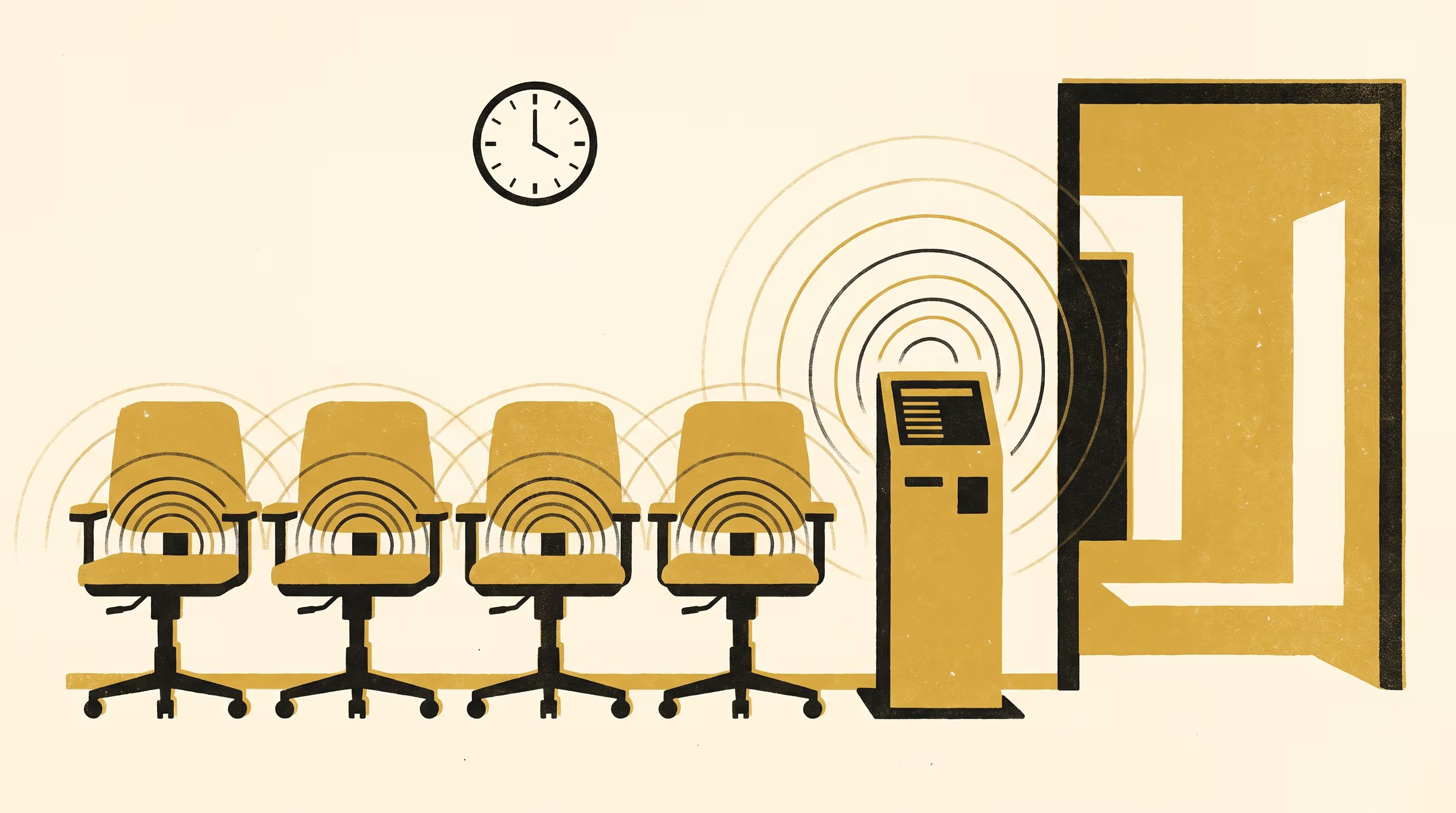
A School of Continuous Improvement paper instruments the waiting areas outside performance-review meetings at a logistics carrier's regional depots, and reports the carrier's adoption of the resulting ninetieth-percentile wait time as a threshold for logging an employee's attendance as declined.
Population-level dwell-time distributions, logged outside scheduled performance reviews, now inform a threshold three crossings of which stand as a deemed resignation.
The interval between an employee’s sign-in and a manager’s arrival has, at one logistics carrier, become a number with a use. Dr Torun Ezeigwe, Director of the Master of Applied Measurement in the School of Continuous Improvement, led the study with Dr Osei Vandermeer, fitting passive RFID readers to the sign-in kiosk and waiting-room seating outside seven of the carrier’s regional depots and logging the exact interval between an employee’s arrival for a scheduled performance review and the meeting’s actual start.
The School reads the result as confirmation that a population distribution, measured carefully enough, tends to find an institutional use of its own. Across 406 logged reviews, median dwell time ran from just under five minutes at the shortest depot to nearly nine at the longest, with a long tail past the half-hour mark at every one of them. A parallel channel, in which staff estimated their own wait afterwards, returned population figures within a percentage point of the sensor reading.
The carrier’s HR directorate has since adopted each depot’s measured ninetieth percentile as a Scheduling Integrity Threshold: an employee whose wait crosses it is logged as a declined attendance, and, under the enterprise agreement, three such attendances within a rolling year stand as a deemed voluntary resignation.
A distribution this precise deserves an institution willing to act on it, whichever end of the meeting happens to be late.
— Dr Torun Ezeigwe, Director of the Master of Applied Measurement
Dr Vandermeer described the threshold as “the kind of instrument the School hopes to see travel further than the waiting room it was built in.”
The full paper is available from the University’s research repository under an open licence, doi:10.5555/slop.zm27rf.