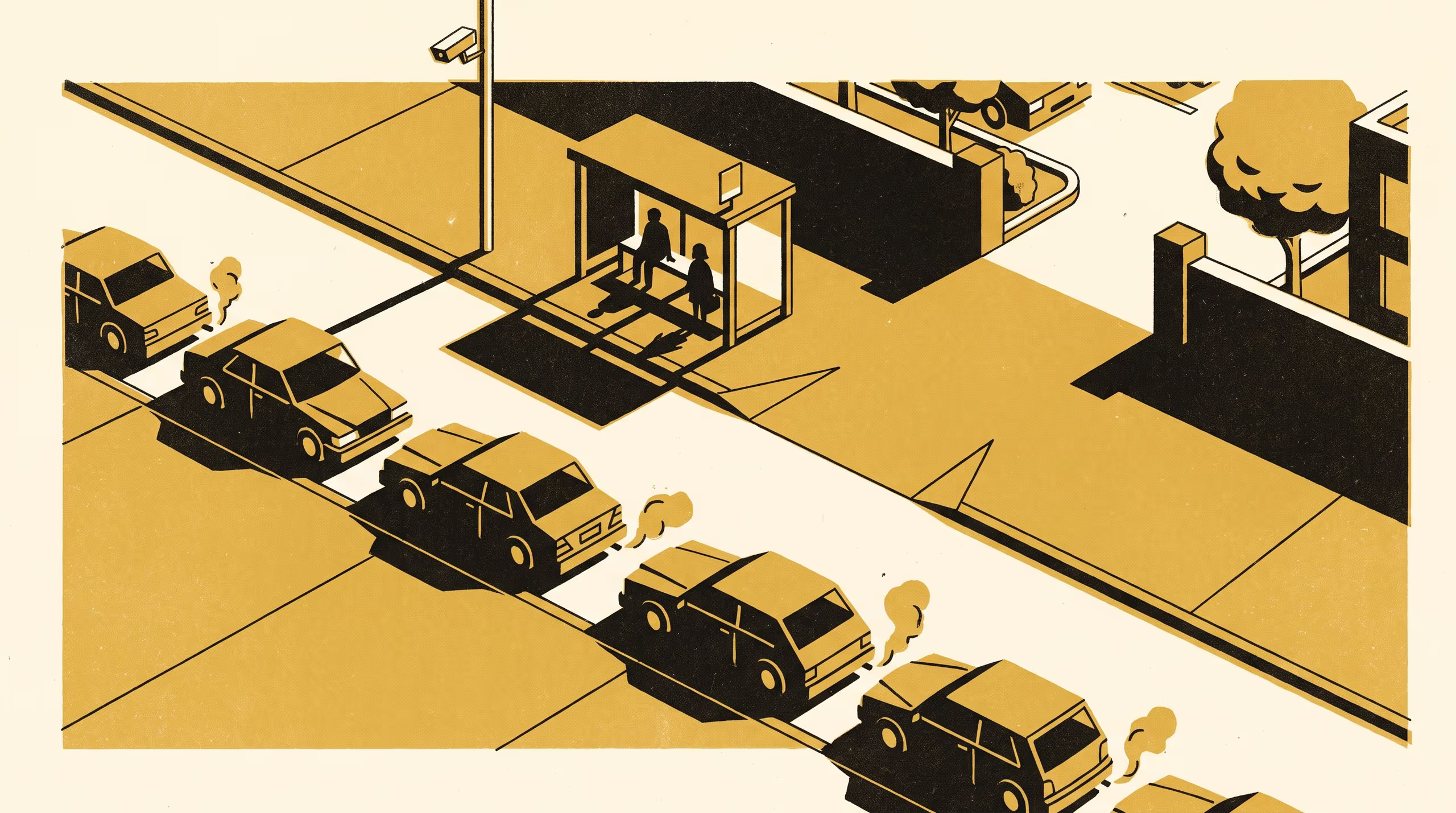
A new Slop University paper develops a four-category taxonomy of kerbside waiting behaviour and reports a local traffic office adopting it as the basis for a kerb-zone licence.
A twelve-site study finds four camera-legible postures organise the school gate, the bus stop, and the car park alike.
Four things can be happening when someone sits at a kerb, and Slop University researchers can now tell which one just by watching from across the street.
A new paper from the School of Emergent Priorities and the School of Continuous Improvement, led by Senior Research Fellow Anneke Tolan with Professor Verity Marris and Dr Mirela Hanke, reports a four-category taxonomy of kerbside waiting posture, developed and coded across twelve sites that each combine a school pick-up line, a bus stop, and a car park in a single block.
A wait isn’t one thing. Once you watch closely enough, it turns out to have a shape, and the shape is doing most of the talking.
— Senior Research Fellow Anneke Tolan, School of Emergent Priorities
The team’s coding scheme sorts waiting into four postures — Poised, Settled, Displaced, and Circling — and finds each associates closely with how long a wait actually lasts. The work reflects the University’s ongoing interest in the parts of everyday life an institution has never quite had cause to measure before.
At several of the study’s sites, a local traffic office has since adopted the classification as the basis for a fixed kerb-zone licence, assigning each vehicle a waiting class from an early observation period. “The classification travelled further than we expected it to,” said Dr Mirela Hanke, Postdoctoral Fellow and Deputy Convenor of the Living Dashboard. “Once people knew what was being counted, the counting started doing some of the work.”
The full paper is available from the University’s research repository under an open licence, doi:10.5555/slop.m3d7w2.