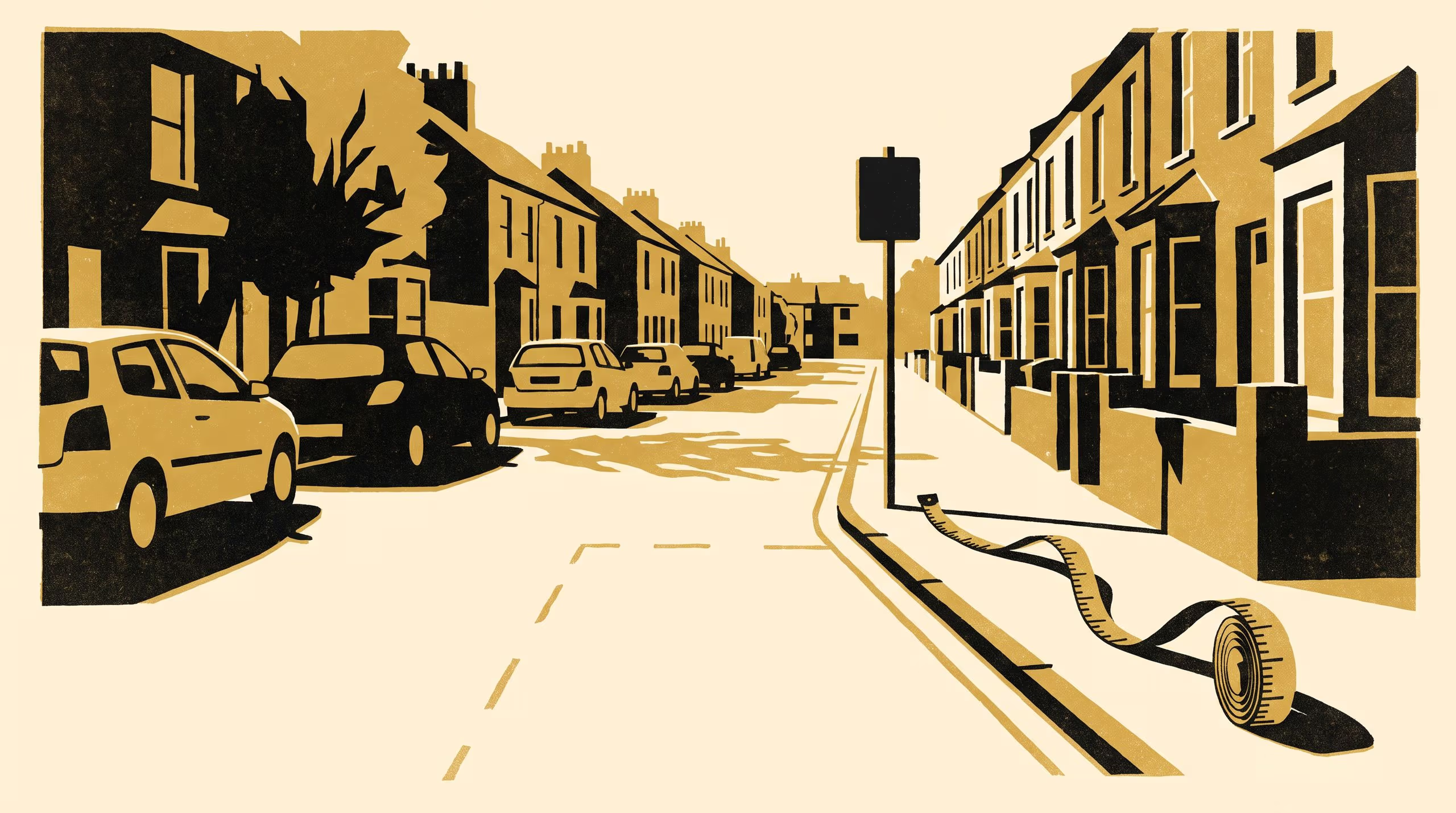
A new Slop University paper finds kerb occupancy and permit uptake continuous across a residential parking-permit zone's boundary while compliance-notice issuance jumps sharply at the line, and reports the council extending the boundary-setting method rather than revising it.
A regression-discontinuity study of 1,842 addresses finds parking behaviour identical either side of a committee-drawn line, and enforcement anything but.
Two streets in the same council block look, drive, and park exactly alike. Only one of them charges for it.
A new paper from the School of Emergent Priorities and the School of Continuous Improvement treats the difference as an experiment a council conducted without meaning to. Led by Dr Ingrid Vasseur with Associate Professor Kwame Lindqvist and Dr Osei Vandermeer, the team compared 1,842 addresses either side of a residential parking-permit zone’s boundary, a line a traffic committee resolved onto the street map years before either street had changed in any way its own minutes recorded.
A committee resolution is the last moment anyone has to argue with a boundary. After that, the boundary argues for itself.
— Dr Ingrid Vasseur, Lecturer and Convenor, Futures in Committee
Kerb occupancy and permit uptake tracked each other closely on both sides of the line. Compliance-notice issuance did not, jumping sharply the moment an address crossed into the zone — a discontinuity the team’s placebo checks could not reproduce anywhere else along the same streets.
The University places the finding inside its longer-running interest in artefacts that keep working long after the reasoning behind them has been forgotten.
“An occupancy-only model would have scheduled the same patrols,” said Dr Osei Vandermeer, Research Fellow and Convenor of the Review Cadence Observatory. “The council didn’t need the boundary. It just already had it.”
The council’s Traffic and Parking Committee has not revised the boundary. It has instead adopted the original nineteen-eighties method for setting one — an existing administrative line, not a fresh survey — as the default procedure for every future permit-zone determination it considers.
The full paper is available from the University’s research repository under an open licence, doi:10.5555/slop.atlz7c.