A School of Continuous Improvement paper elicits grams, millilitres, and minutes for the undefined units of the home recipe across 247 cooks, finds agreement ends at the kitchen door, and publishes a reference table it advises every kitchen to re-derive for itself.
Concealed scales in 61 kitchens find recipe words carry real quantities that agree within a household and hardly at all between strangers
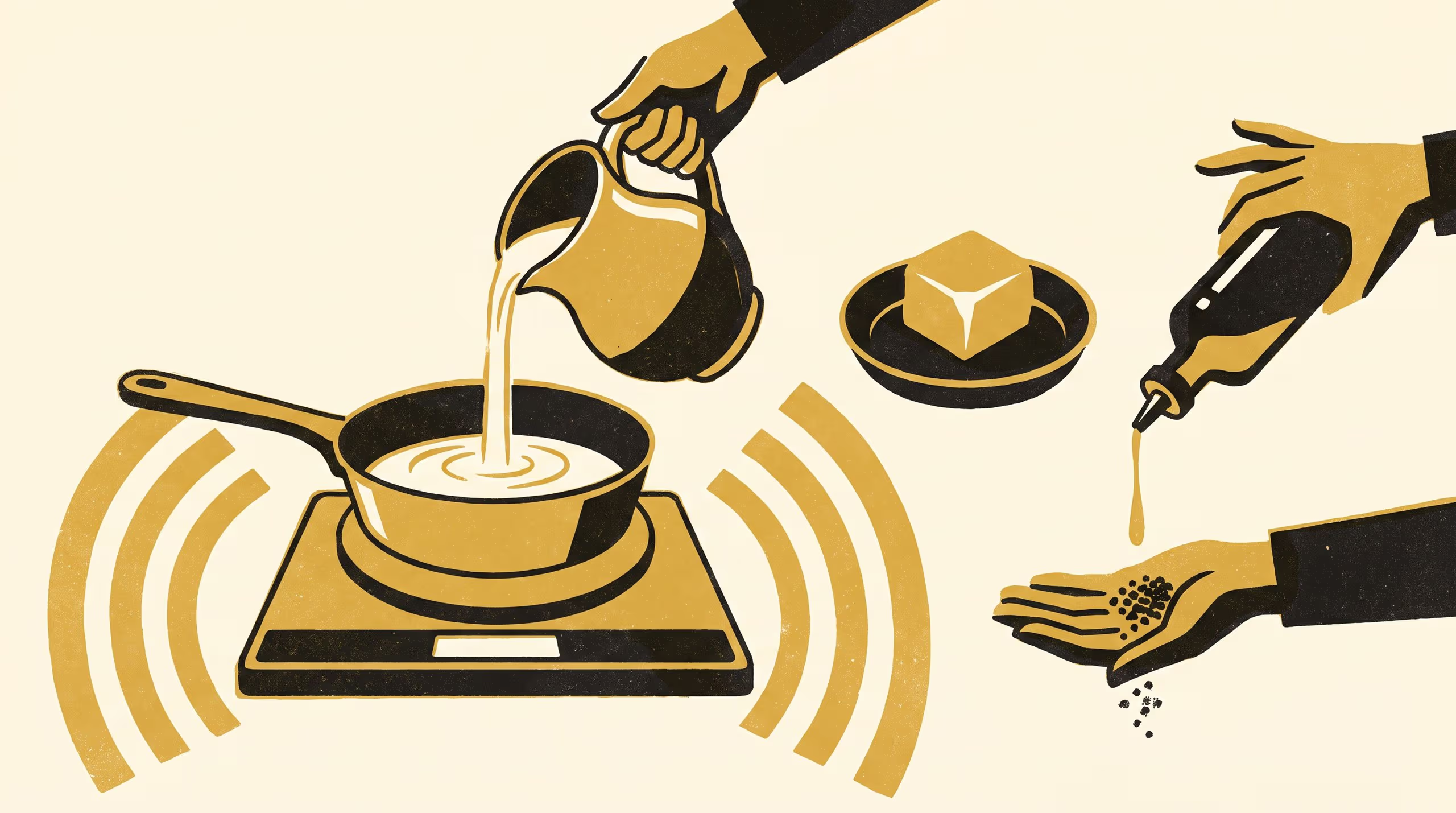
The scale was under the pan for every one of the 8,892 pours, dispensings, and pinches; the cooks were never once shown its display. What it recorded is the subject of Calibrating the Knob of Butter, a paper released today by the School of Continuous Improvement, which sets out to answer a question printed recipes have been quietly declining to answer for as long as there have been printed recipes: how much, exactly, is a splash?
The answer, the paper reports, depends on whose kitchen you are standing in. Across 247 cooks, 61 kitchens, and 24 family lines, terms like the knob, the glug, and the pinch turn out to carry real and stable quantities — but the agreement is local, holding strongly within a household, moderately along a family line, and hardly at all between strangers. Cooks also proved far more consistent in the hand than in the telling, dispensing the same quantity again and again while misstating their own practice by wide margins.
What moved us was the consistency. A kitchen knows what it means by a knob of butter, and has known for a long time; the paper is the University arriving late and taking notes.
— Dr Torun Ezeigwe, Senior Lecturer and Director, Master of Applied Measurement
The study harmonises concealed-scale dispensing, spoken estimates, and stop-the-video doneness judgements into a single account of the domestic quantity lexicon, decomposing its variance by term, cook, kitchen, and family line. The work extends the School’s standing commitment to measurement wherever it is practised, whether or not anyone has defined it. The paper closes with a Domestic Reference Units table, offered in full earnest, together with the advice that any kitchen intending to rely on it should first produce its own.
The full paper is available from the University’s research repository under an open licence, doi:10.5555/slop.xobnx7.