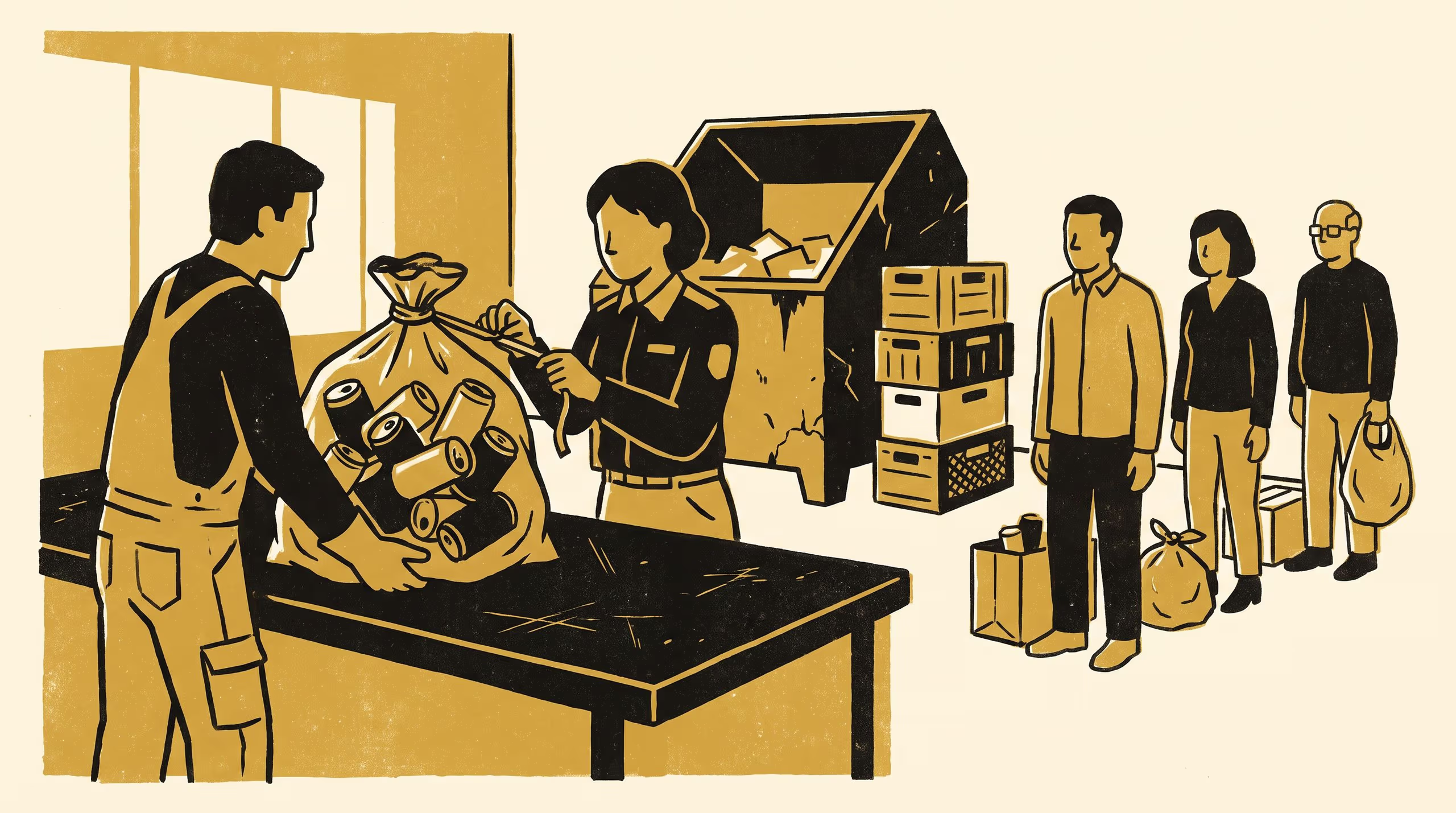
Researchers from both Schools modelled the counter at which the public hands over containers for a refund, finding the stage that binds capacity sits on the customer's side of the bench rather than the operator's.
A discrete-event model built from 14,208 timed handovers at eleven privately operated container-refund depots
Adding a second counting bench to a container-refund depot buys about a twentieth more throughput. Changing how the bags arrive buys four times that.
Towards a Discrete-Event Model of Container-Refund Depot Throughput, released today, reports a simulation of the over-the-counter refund transaction at eleven privately operated depots. The counter’s work separates into four stages, and the one that governs capacity turns out to be the stage in which the load is made available to the operator: a mean 31.4 per cent of handover duration, and the greater part of its variance. A double-knotted bag takes 104.2 seconds to process against 40.1 for a rigid crate.
Half of what happens at that counter is done by the person on the public side of it, and none of it was ever in anybody’s numbers. Putting it there has left the School with a question about how it measures everything else.
— Dr Anouk Mensah, Postdoctoral Fellow, School of Emergent Priorities
Observers timed four stage boundaries in every transaction across fourteen trading days per site, coded each load by how it had been closed, and fitted the results into a model calibrated against each depot’s own daily record. The University regards the work as an addition to the measurement infrastructure it has been extending into ordinary commercial settings, where capacity is planned without much to plan from.
The model has since been offered to participating operators as a configuration-review service, and reduced to a short presentation specification for counter signage. Dr Solveig Adeyemi, Lecturer in the School of Continuous Improvement, said the study was the kind of collaboration between the two Schools the University would like to see more of, and that the operators who hosted it had shaped the method as much as the finding.
The work was supported under the Indicator Stewardship Seed Fund. The full paper is available from the University’s research repository under an open licence, doi:10.5555/slop.nkxa2l.