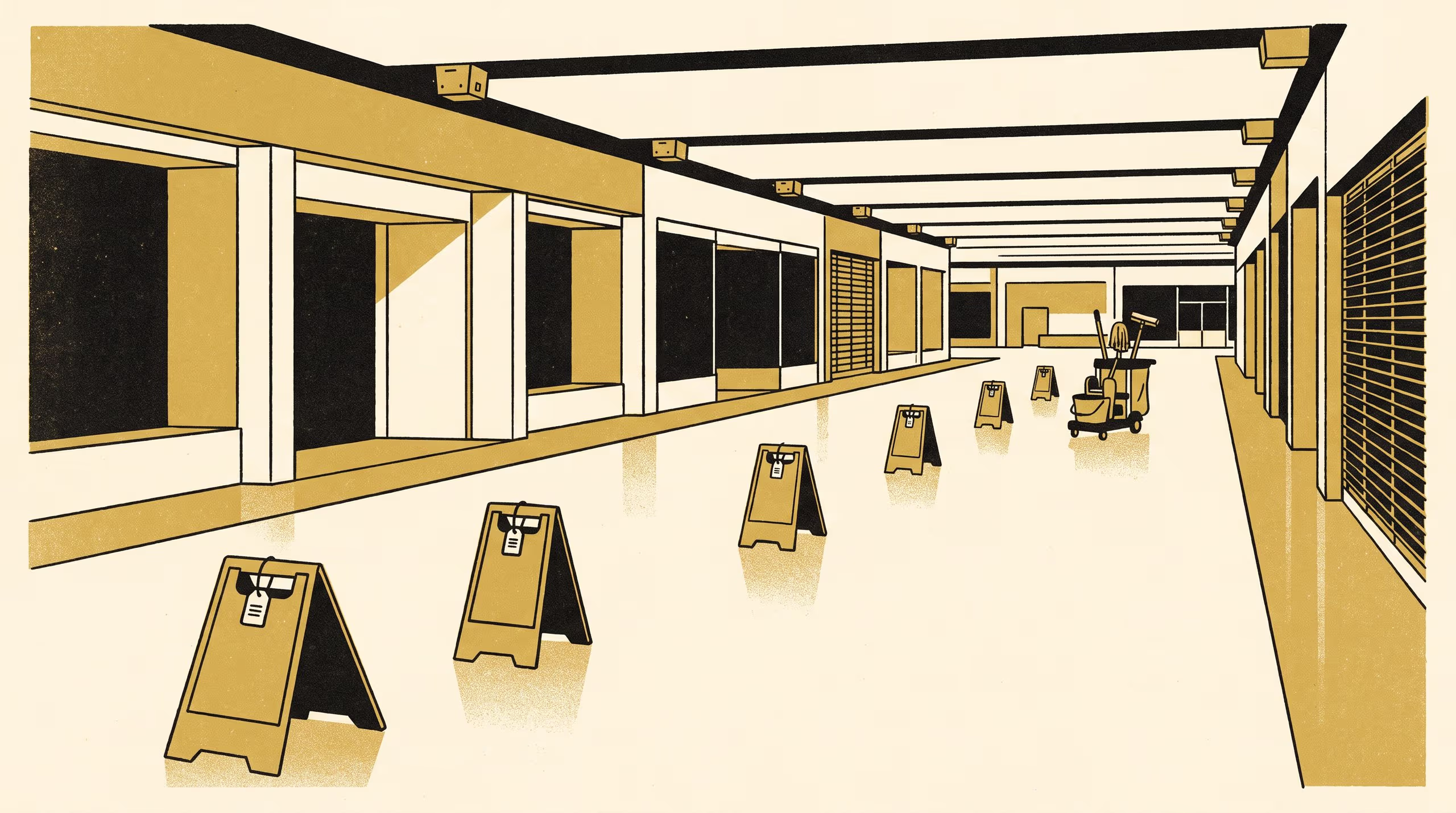
School of Emergent Priorities researchers fitted folding hazard cones with ultra-wideband tags and recovered the first continuous record of where they stand and for how long, finding a median episode of 41 minutes and a longest of 34.2 days.
Fourteen weeks, 412 tagged cones and 8,614 deployment episodes across three regional shopping centres
The School of Emergent Priorities has spent this year putting instruments on objects that nobody had thought needed them. The newest is the folding yellow cone that stands beside a wet floor.
CAUTION: Cone-Aware Utilisation Tracking in Occupied Networks, a paper released today, describes a sensing platform built at the School and deployed for fourteen weeks across three regional shopping centres. Four hundred and twelve cones carried a tag on the hinge; anchors in the ceiling void resolved each one to a zone and to whether it was stowed, moving, or standing. The result is 8,614 deployment episodes, a continuous record of an object that has until now generated none.
The School spent a long time deciding whether this was a question worth asking, and rather less time than that answering it once the tags were on.
— Fenna Okoro, Senior Lecturer and Convenor of the Horizon Register
What the record shows is that a cone’s working life comes in two kinds. The middle episode lasts 41 minutes. The longest ran 34.2 days, in a back-of-house service corridor, and the corridor turns out to carry more standing cones at any hour than any shopping floor in the study.
The release sits within a longer effort by the University to bring sensing to the parts of a building that generate no record of themselves, and to make what is currently attested available to be counted instead. Lead author Petra Umbile, a Postdoctoral Fellow in the School, noted that “the cleaning and facilities teams at the three centres carried a tag on every cone for fourteen weeks and told us whenever one came off, which is most of what made the trace usable at all”.
The recovered trace has been lodged with the Indicator Commons under an institutional schema, and cone-hours is now carried as a monthly series.
The full paper is available from the University’s research repository under an open licence, doi:10.5555/slop.hgk1nh.