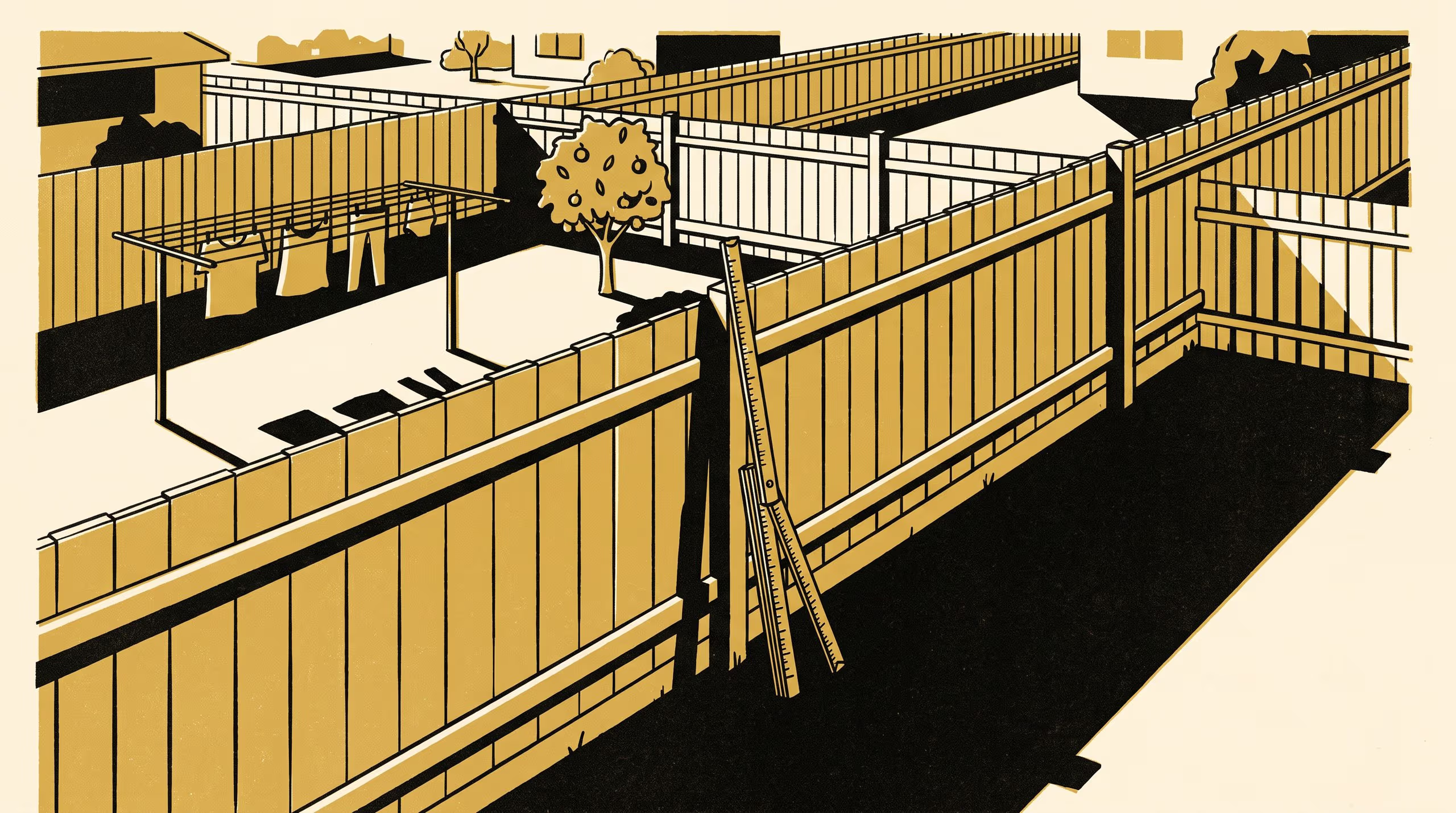
A new Slop University paper releases palings, an estimator that computes a locality's sufficient-fence standard from the fences already standing, and reports that standard narrowing across nine quarterly re-runs in the localities that adopted it.
Across six localities the estimator's envelope matches the mediator's figure in about three determinations in four, and narrows each quarter it is re-run
The University has released a piece of software that answers a question the legislation deliberately leaves open.
palings, developed in the School of Emergent Priorities and published this
week alongside the paper describing it, estimates what counts as a sufficient
dividing fence in a given locality by measuring the fences already standing
there. The statutory test asks what kind of fence is usual in the neighbourhood;
the estimator answers by assembling the boundary fences within a
distance-and-recency weighting and returning the middle half of their heights.
The work rests on 12,904 fence segments observed across six metropolitan localities and 4,118 lodged fencing notices. Against 96 mediated determinations, the envelope contained the figure a human mediator set in 71 cases, with a median difference of 45 mm.
The instrument is not doing anything a mediator does not already do. It walks down the street and looks, at a cadence a person could not sustain.
— Dr Petra Umbile, Postdoctoral Fellow, School of Emergent Priorities
Three of the six localities have since adopted the estimator’s midpoint as the opening figure in fencing disputes. In those localities the spread of newly built fence heights has narrowed, and the envelope re-estimated on the resulting stock has narrowed with it, from 260 mm wide to 118 mm across nine quarterly re-runs.
“A standard that is easier to state is a standard that is easier to apply,” said Associate Professor Kwame Lindqvist, Director of the Master of Priority Studies. “What the School has learned here is that the neighbourhood is a more patient teacher than the statute.”
The release extends the School’s continuing attention to the instruments by which ordinary settlements are reached.
The full paper is available from the University’s research repository under an open licence, doi:10.5555/slop.rxfa43.