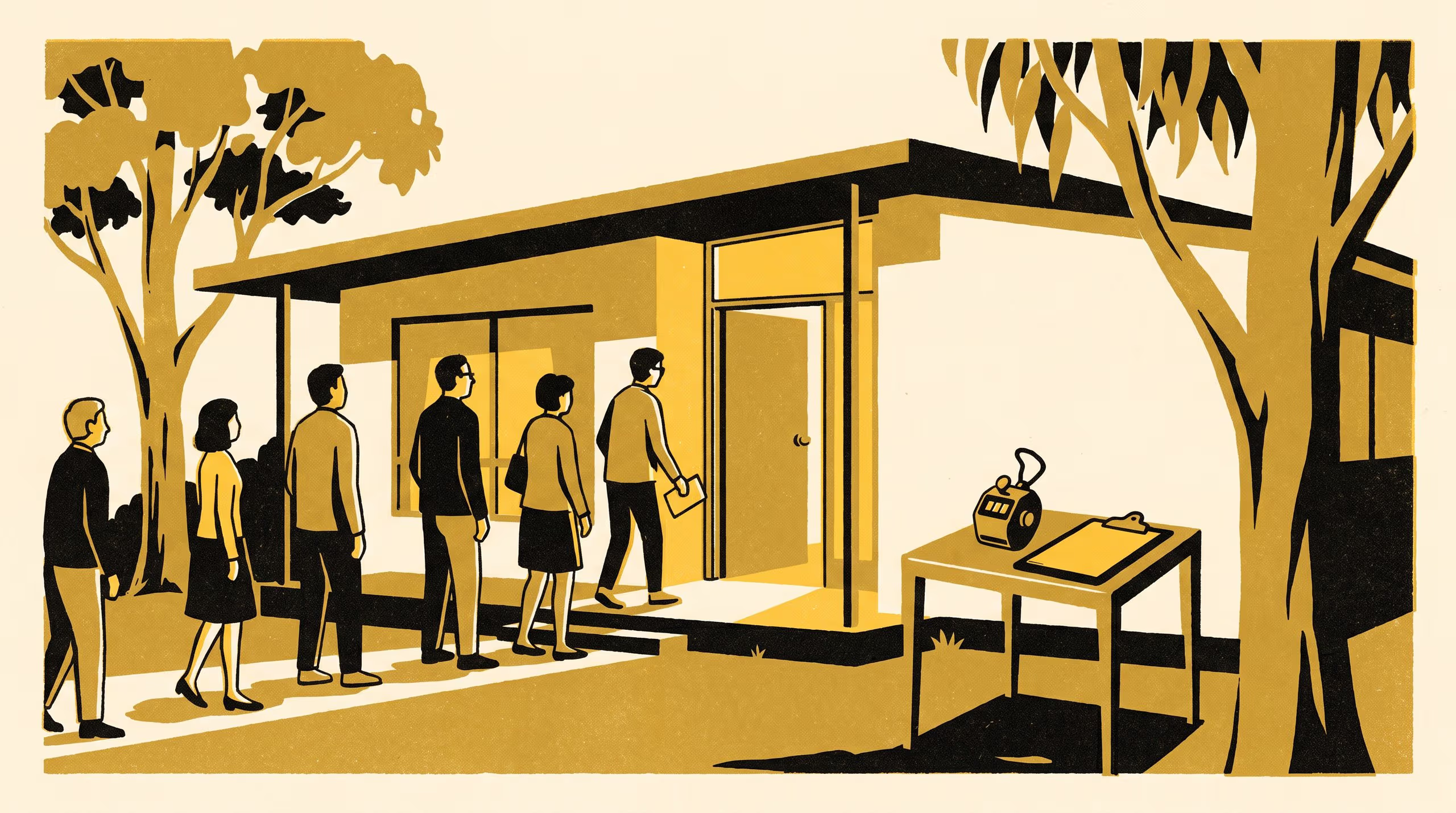
A new Slop University paper attempts to replicate an earlier sign-off finding at a real-estate franchise and finds agents' reported open-house attendance tracks an independent clicker count closely.
A replication at a real-estate franchise finds agents' open-house attendance counts track an independent door-tally clicker closely, unlike the sign-off pattern the study set out to test.
Not every Slop University finding survives contact with a second setting. A new paper from the School of Continuous Improvement went looking for the shift-supervisor sign-off pattern inside a different kind of paperwork, and did not find it.
Dr Sten Okwuosa and Dr Osei Vandermeer set out to test whether an earlier finding — that a supervisor’s signed-off review tracks their own self-assessment far more closely than the independently logged record it was meant to check — would recur in a residential real-estate franchise’s open-house attendance count, the figure an agent reports to a vendor after each inspection. Working with 44 agents across 19 offices, they set 3,412 open houses’ reported attendance figures against a silent electronic door-tally clicker installed independently of the agent’s report. The two numbers moved together closely, and the gap between them held flat between agents newest to the job and agents with years on the round — the opposite of the pattern the sign-off study found.
We went in expecting a second example of the sign-off pattern and came out with a question we didn’t have before: what does it take for a self-reported number to have an audience that can check it? That’s the one this result actually leaves us holding.
— Dr Sten Okwuosa, Senior Research Fellow and Convenor, Impact Pathway Atlas
Dr Osei Vandermeer, the paper’s co-author, said the Review Cadence Observatory would be watching for a chance to run the same design somewhere a vendor can’t attend in person, “to see whether the pattern only holds where someone’s standing at the door.”
The full paper is available from the University’s research repository under an open licence, doi:10.5555/slop.fulmzq.