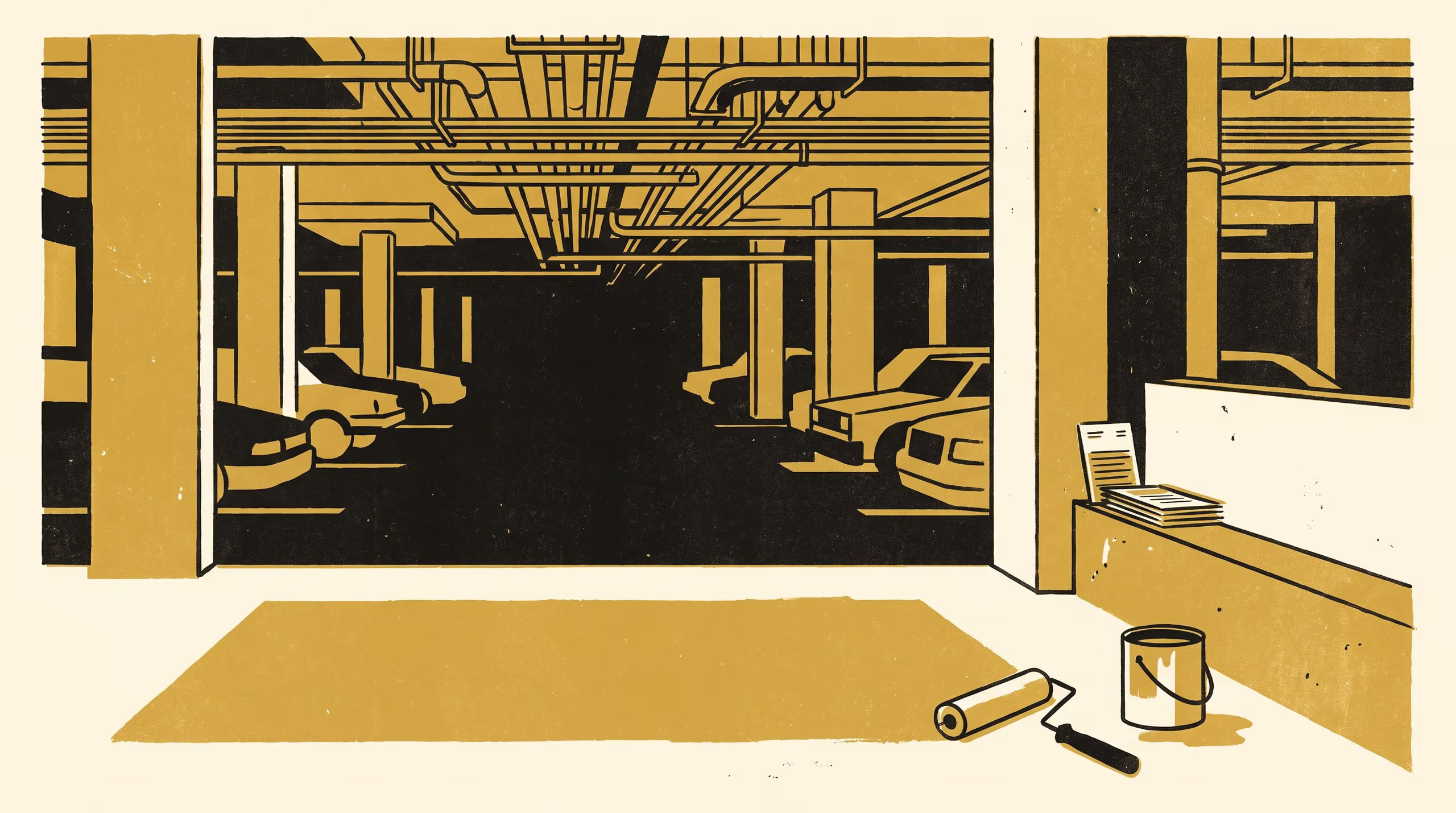
A new Slop University paper classifies 163 car-space ownership transfers on a two-axis maturity model, finding the physical stencil naming a bay's owner is corrected well before a strata committee ever formally notes the change.
Across 21 strata schemes, a stencilled car-space name usually catches up weeks before any committee minutes record the change
Twenty-one strata schemes, five management firms, and thirty-nine months of committee minutes went into the School of Emergent Priorities’ newest study of a fixture most residents stop noticing after their first week in the building: the stencilled name beside a numbered car space.
We went looking for the moment governance catches up with the concrete, and mostly found the concrete had already moved on.
— Dr Ingrid Vasseur, Lecturer and Convenor, Futures in Committee
The paper, from Dr Vasseur, Associate Professor Kwame Lindqvist, and Dr Lindiwe Achterberg, tracks 163 car-space ownership transfers across the twenty-one schemes on two measures at once: how quickly a bay’s painted name is corrected to match its new owner, and how quickly a scheme’s committee formally minutes the same transfer. Plotted against each other, the two measures sort transfers into a four-way maturity model, and more than half land in the quadrant the paper calls “ahead of the minute” — the paint already right, the paperwork still catching up.
“The School has always treated a lagging record as data in its own right,” said Associate Professor Kwame Lindqvist, “and this one obliges by lagging in a very countable way.”
The finding carries a second edge for schemes reporting their own signage compliance upward: a figure built from the minute book, the paper suggests, is measuring the slower of two clocks.
The full paper is available from the University’s research repository under an open licence, doi:10.5555/slop.j9cyre.