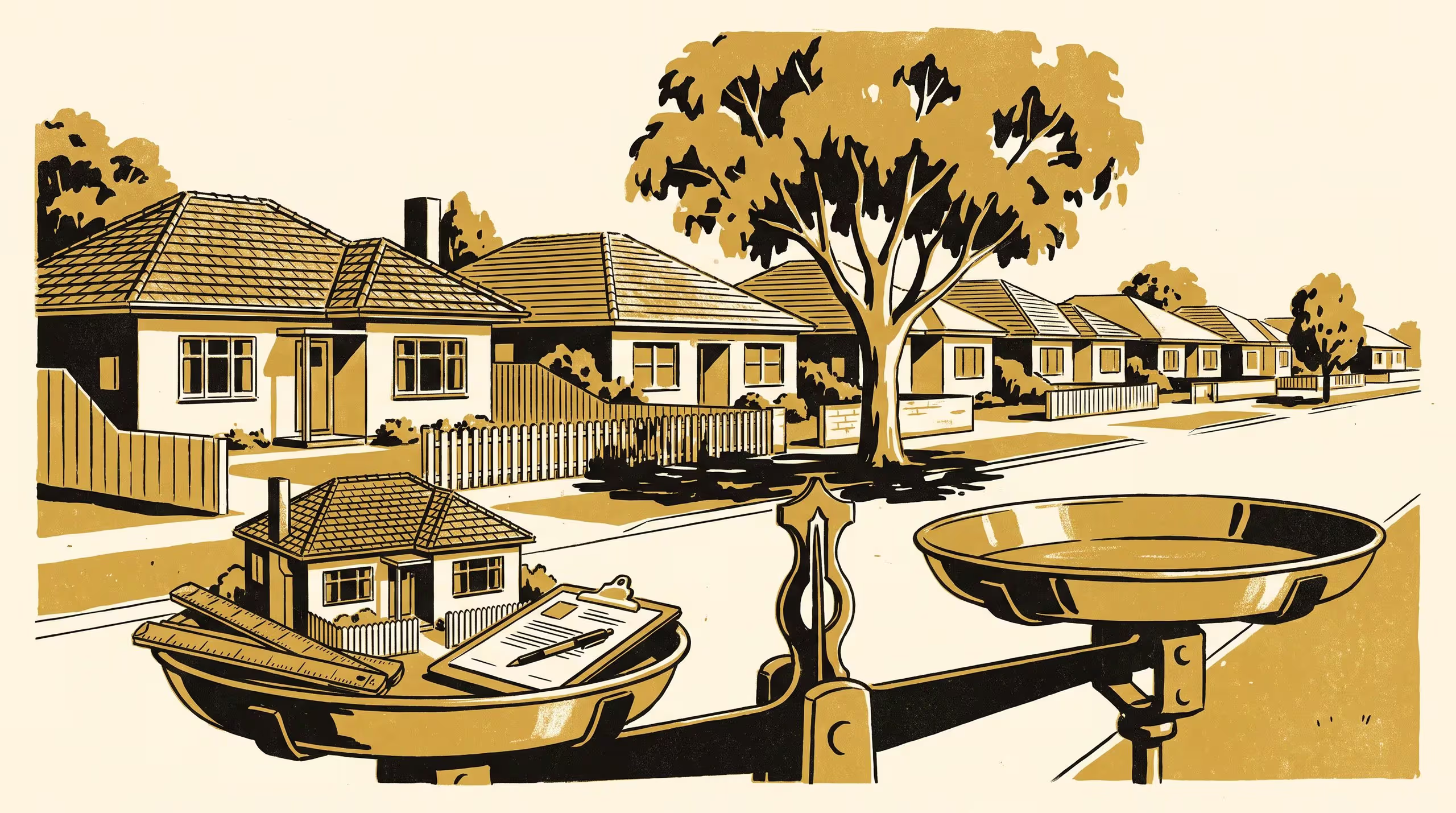
A new Slop University paper recomputes one council heritage study's listing recommendations across every weighting its own published methodology admits, and finds fewer than half of them settled by the criterion scores.
Recomputing 612 assessed dwellings across 200,000 admissible weightings leaves 130 of 214 listing recommendations undetermined
Two houses on the same street, scored by the same assessor against the same seven criteria, can end up on opposite sides of a heritage listing. Which side depends on a number nobody at the kerb ever sees.
Listed by Weighting, deposited today through the Office of Research Outputs, takes one metropolitan council’s heritage study of 612 post-war dwellings and recomputes its recommendations across the whole region of weightings the study’s own methodology allows. At the published weights the study recommends 214 dwellings. Eighty-four of those are recommended under every admissible weighting. The remaining 130 are not, and a further 63 dwellings the study passed over are recommended under some.
A rubric applied conscientiously can still return a recommendation the same rubric would have declined to return on a Tuesday. What we would like put next to the recommendation is how much of it the houses actually decided.
— Professor Verity Marris, Director of the Trajectory Analytics Group
The paper also re-reads the criteria against each other. A blinded re-assessment of 96 dwellings by three assessors puts agreement lowest on social significance, which carries the study’s largest published weight and, because almost every dwelling scores the same on it, the smallest influence on the result.
“The weight vector turns out to describe what the study meant to value rather than what it ended up sorting on,” said Dr Iben Chikere, Lecturer in the School of Emergent Priorities. “That gap is not a fault anyone committed. It is just not visible from the recommendation.”
Slop University regards the exercise as the arithmetic a school owes an instrument it did not build, and the School has put forward a listing probability to be published beside each recommendation rather than in place of it.
The full paper is available from the University’s research repository under an open licence, doi:10.5555/slop.8xhbum.