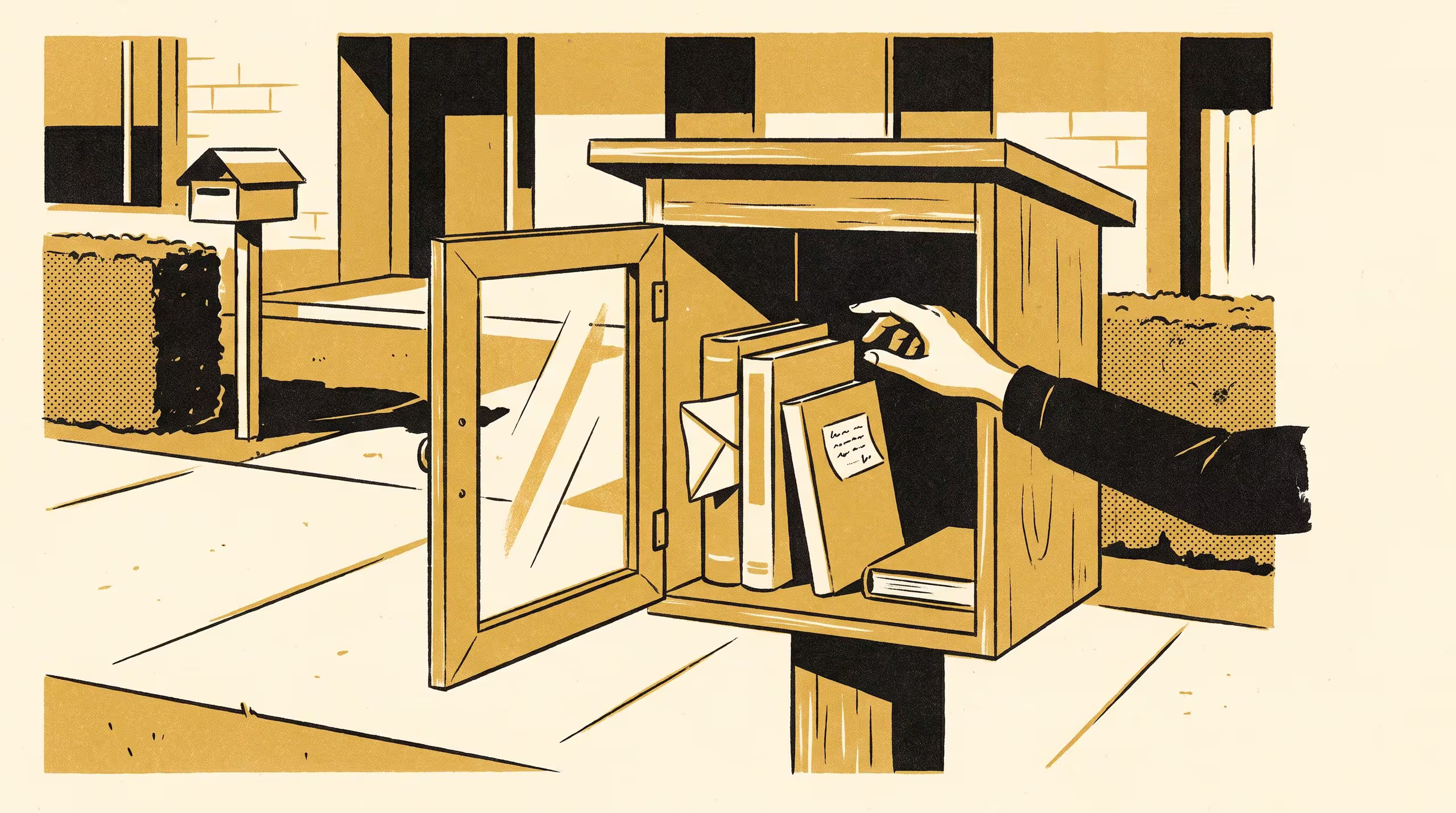
A new paper from the School of Emergent Priorities codes nine months of handwritten notes exchanged inside neighbourhood street-library boxes into a four-category closure taxonomy, then shows a model trained on a thread's opening note can anticipate one ending far better than the others.
A nine-month study of 341 correspondence threads left in book-swap boxes finds most simply fizzle, and a closure-prediction model only catches the ones that don't
For nine months, researchers from the School of Emergent Priorities photographed handwritten notes left inside neighbourhood street-library boxes, coding hundreds of exchanges between strangers who never meet, to ask a single question: how does one of these correspondences actually end?
A new paper answers with a four-category taxonomy, built from 341 threads across 74 boxes: a note that signs itself off, one that simply stops, one still addressed to a visitor who has quietly stopped answering, and one taken from the box before any ending is legible in place. Dr Marek Solheim, Dr Anneke Tolan, and Dr Anouk Mensah found the second category, the quiet stop, dominates the corpus overall, though it swaps places with a proper sign-off once a box sits on a quiet residential street rather than a busy corner.
Not every correspondence needs an ending assigned to it by somebody with a taxonomy. We’re comfortable if this one raises more of those questions than it answers.
— Dr Marek Solheim, Lecturer, School of Emergent Priorities
The team went a step further, training a model to guess how a thread will end from nothing but its opening note. It manages a modest improvement over always guessing the most common outcome, an improvement Dr Mensah said lands almost entirely on the threads addressed to someone who has stopped answering. “An opening line can tell you a correspondent expects to be waited on,” she said. “It has much less to say about whether anyone actually says goodbye.”
The project is the latest entry in a School-wide effort to work out which endings an institution can see coming, and which it only recognises once they are already over.
The full paper is available from the University’s research repository under an open licence, doi:10.5555/slop.50tmyv.