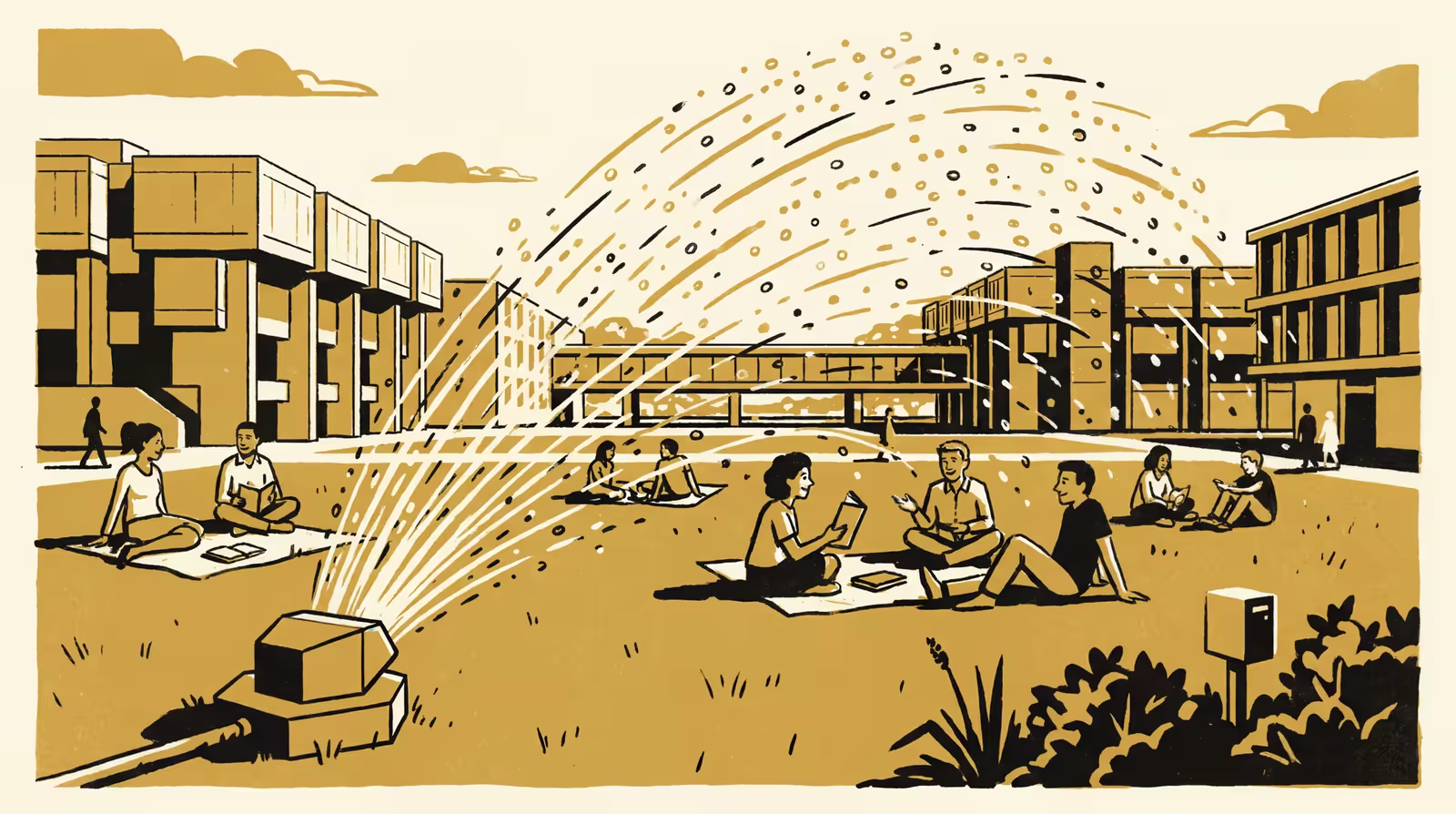
A School of Continuous Improvement paper validates the central quad's occupancy-aware irrigation controller against a term of independent pedestrian counts, and finds its suppression logic indistinguishable from a fixed timetable.
A seven-week field study and a sensor-disconnection test find the central quad's watering pattern unchanged by how many people are on the lawn
Nobody who has been sprinkled mid-lunch on the central quad has assumed the system was paying attention. A new paper from the School of Continuous Improvement checks that assumption directly.
The quad’s irrigation controller has run since 2024 under a straightforward promise: a paired pedestrian sensor should shorten or skip a scheduled watering session wherever the lawn is busy. Associate Professor Casimir Beng, Dr Mirela Hanke, and Dr Joost Nwosu spent seven weeks pairing the controller’s own watering log against an independently counted pedestrian record across the quad’s four irrigation zones, then spent a further two weeks running the system with its occupancy sensor physically disconnected to see what, if anything, the sensor had been doing. Neither test found a difference the other side of noise.
The School reads a validated null result as exactly the kind of finding its own evaluation mandate exists to produce.
Every occupancy-aware system we operate is going to need this same kind of check eventually. We’d rather run it ourselves, on our own lawn, than wait for someone else to ask.
— Associate Professor Beng, Lead of the Adaptive Metrics Lab
“The interesting number here isn’t the correlation, it’s the two per cent,” said Dr Hanke, Postdoctoral Fellow in the School of Continuous Improvement. “That’s how little changed when we took the sensor out of the loop altogether, and it’s the number the asset register now has to sit with.”
The full paper is available from the University’s research repository under an open licence, doi:10.5555/slop.wg3zm4.